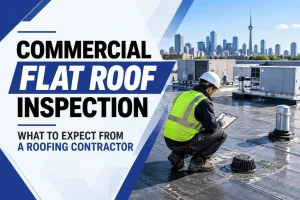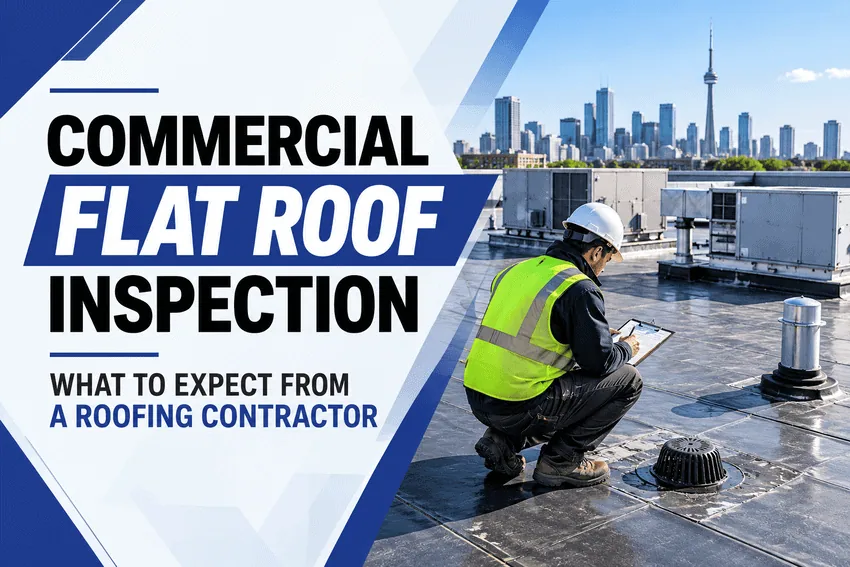
When a roofing contractor arrives to inspect a commercial flat roof, the inspection usually starts with the areas that are easiest to overlook during day-to-day building operations. The roof membrane, seams, flashing, drains, roof edges, penetrations and areas around rooftop equipment all need to be looked at.
If the building leaks, that location will get attention, but it is rarely enough to look directly above the ceiling stain and stop there. Water can move through a roofing system before it becomes visible inside the building. A good inspection follows the evidence and checks the surrounding roof details as well.
For a property owner or facility manager, the useful part comes after the inspection. You should come away knowing what the contractor found, which conditions need attention, and whether anything needs a closer investigation.
Why Inspect a Commercial Flat Roof?
A commercial roof can spend months looking fine from the ground while small problems develop above it. A damaged seam, blocked drain or deteriorated flashing detail may not cause an immediate leak. Over time, however, water can reach areas of the roof assembly that are difficult to see from the surface.
Commercial and industrial roofs also have a lot going on above the membrane. HVAC units, vents, pipes, electrical equipment, curbs and other penetrations create additional areas that need to be checked.
Regular roof inspections give building managers a record of these conditions. They can also make it easier to decide whether an issue should be dealt with now or included in planned roofing work.
What Happens Before the Inspection?
The contractor will usually want some background on the building before starting the roof assessment.
If there is a known leak, the property manager should explain where it appears and when it usually happens. A leak that shows up during heavy rain, for example, can provide a useful starting point for the investigation. Previous repairs are also worth mentioning, especially if the same area has leaked more than once.
The contractor may also review:
- The age and type of roofing system
- Previous inspection reports
- Repair and maintenance records
- Known problem areas
- Recent work on the roof
- New HVAC or mechanical installations
- Areas where water has entered the building
This information gives the inspection some context. It also helps the contractor avoid treating an old repair or recurring leak as an isolated problem.
What Does a Commercial Flat Roof Inspection Cover?
There is no single inspection routine that works for every building. A warehouse with a large open roof will have different requirements from a multi-tenant commercial property with several rooftop units and numerous penetrations.
Still, several parts of the roof deserve attention during almost every commercial flat roof inspection.
Roof Membrane
The membrane is the main weatherproofing layer, so its condition is one of the first things to assess.
The inspection will look for visible damage such as punctures, cuts, open seams, blisters, wrinkles, splitting, surface deterioration and signs of previous patching.
The roofing material also matters. TPO, EPDM, modified bitumen and other commercial roofing systems have different construction details and common failure points. The condition of the membrane should therefore be considered in relation to the particular system installed on the building.
A small defect does not automatically mean major roofing work is needed. Its size, location, surrounding conditions and history all matter.
Seams and Joints
Seams deserve a close look because they connect sections of membrane and can become vulnerable as a roof ages.
The contractor will check for separation, damage, failed adhesion or other visible changes along the seams. Previous repairs can also provide clues, particularly when the same seam has been repaired repeatedly.
On some membrane systems, seam condition can be an important indicator of how the roof is holding up overall.
Roof Drains and Drainage
Water needs a clear path off a flat roof.
During an inspection, drains, scuppers and other drainage points are checked for debris, blockage, damage and signs of poor drainage. The contractor will also look for evidence that water has been sitting on the roof.
Aviva’s commercial flat roof inspection guidance specifically recommends checking for standing water or evidence of previous standing water, along with clogged drainage components.
Ponding should not automatically be blamed on the membrane. The reason could be a blocked drain, an issue with the roof’s slope, deflection or another drainage-related condition. Finding the cause is more useful than simply noting that water was present.
Flashing and Roof Edges
Flashing is used where the roofing system meets walls, curbs, parapets, equipment and other vertical surfaces.
These transition areas can be difficult to repair properly if they have deteriorated, so the contractor will look for loose materials, gaps, damaged sections, failed sealants and other visible problems.
Roof edges and coping should also be checked. Damage in these areas can expose the roofing system to water and wind and may affect the way the roof performs around its perimeter.
Roof Penetrations
Commercial buildings can have dozens of items passing through or sitting on the roof. Pipes, vents, conduits, skylights, exhaust systems and HVAC equipment all create details that have to be properly integrated with the roofing system.
The inspection should look at the membrane and flashing around these penetrations rather than treating the open roof area as the only concern.
Current commercial roofing inspection guidance also puts particular attention on penetrations and equipment curbs because these areas can develop complicated repair histories over the life of a building.
Rooftop Equipment
The contractor is not there to service the building’s HVAC equipment, but the equipment still matters to the roof inspection.
The area around a rooftop unit can have additional flashing, penetrations, drains and service traffic. Equipment can also affect water movement across the roof.
NRCA guidance notes that rooftop mechanical equipment should not restrict drainage and that water discharged from mechanical equipment should not be allowed to collect on the roof surface.
The inspection should therefore consider the condition around the equipment as well as the roof itself.
How Are Roof Leaks Investigated?
A leak reported inside the building does not always point directly to the location where water entered the roof.
For example, water may enter around a penetration and travel along part of the roof assembly before appearing above a ceiling. That makes it important to look at the surrounding roof area rather than assuming the closest visible defect is the source.
A visual inspection may be enough to identify the cause in some cases. In other situations, additional investigation may be necessary.
Depending on what is found, a contractor may recommend moisture testing or another form of leak investigation. Current commercial roofing inspection practices use visual assessment as a starting point and bring in additional testing when the visible evidence is not enough to determine what is happening below the surface.
That distinction should be clear in the inspection report. A visible defect is one thing. Confirmed concealed moisture is another.
What About the Insulation and Roof Deck?
A standard visual inspection cannot reveal everything underneath the membrane.
If there are signs that moisture may have reached the insulation or roof deck, the contractor may recommend a more detailed assessment. Depending on the situation, that can include moisture scanning or other testing.
This is particularly relevant when a roof has a history of leaks, unexplained soft areas or repairs that have not solved the problem.
The important question is not whether every roof should be opened during an inspection. It is whether the available evidence is enough to understand the condition of the roofing system.
Will Previous Repairs Be Checked?
Yes, previous repair areas can tell the contractor quite a bit about the roof.
Old patches, repaired seams, replacement flashing and sealant work are worth noting. If several repairs are concentrated in one area, that may point to a recurring problem.
A roof with a few isolated repairs can still be performing well. Repeated failures in the same location deserve closer attention because the visible repair may not have addressed the underlying issue.
Keeping records of past roofing work makes this part of the inspection much easier. It gives the contractor a history to work from instead of starting with the assumption that every problem is new.
What Should a Commercial Roof Inspection Report Tell You?
The inspection report should be useful to someone who was not standing on the roof.
Photographs are particularly helpful. A property manager may need to discuss the findings with an owner, asset manager, maintenance team or finance department, and a photograph of the actual roof condition is much easier to work with than a vague description.
A useful report can include:
- Areas inspected
- Roof membrane observations
- Drainage conditions
- Flashing and edge conditions
- Penetration and equipment observations
- Photographs of significant findings
- Areas with previous repairs
- Conditions that need monitoring
- Recommended next steps
The report should also distinguish between an observed condition and something that has been confirmed through additional testing.
For commercial property managers, keeping these reports from one inspection to the next can be valuable. It creates a history of the roof and makes changes easier to spot.
What Happens After the Inspection?
The answer depends on what the inspection found.
If the roof is in reasonable condition, the recommendation may be to continue monitoring it and deal with minor issues through planned maintenance.
For properties that need ongoing care, PWCR provides commercial roof maintenance as part of its commercial roofing services.
If the inspection finds a localized problem, such as damaged membrane, flashing or seams, the next step may be targeted repair. PWCR provides commercial roof repair for commercial properties requiring corrective roofing work.
A roof with widespread deterioration may require a different conversation. If the condition, age and repair history point toward a larger project, property owners can review PWCR’s commercial roof replacement services.
Sometimes the inspection does not provide enough information to make that decision. In that case, additional investigation may be the sensible next step.
How Often Should a Commercial Flat Roof Be Inspected?
The right inspection schedule depends on the building and the roofing system.
A newer roof with a straightforward layout may have different inspection needs from an older industrial building with extensive rooftop equipment, multiple penetrations and a history of leaks.
The building’s maintenance history, weather exposure, roof age and previous repairs should all be considered when deciding how often inspections are needed.
An inspection is also worth considering after significant weather damage or when a new leak appears. A change in the roof’s performance is usually a good reason to have the condition checked rather than waiting for the problem to become more obvious.
What Should Facility Managers Ask After the Inspection?
Once the contractor has completed the inspection, the property manager should be able to have a straightforward conversation about the findings.
A few useful questions are:
Which problems need attention now?
This helps separate urgent concerns from items that can be handled during planned maintenance.
Are the problems limited to one area?
A localized membrane issue is different from deterioration found across several sections of the roof.
Was any water intrusion confirmed?
This is especially important when the inspection was prompted by an interior leak.
Are the drains and other drainage points working properly?
Poor drainage can create problems even when the membrane itself appears to be in reasonable condition.
Does anything need further testing?
If the contractor suspects concealed moisture or another issue that cannot be confirmed visually, ask what testing is recommended and what it is expected to determine.
What should be monitored?
Not every observation requires immediate repair. Knowing what to watch gives the facility team a practical plan for the months ahead.
Why Commercial Flat Roof Experience Matters
Commercial and industrial roofs can be complicated.
A single building may have several membrane sections, rooftop HVAC units, drains, parapet walls, equipment curbs, expansion joints, pipes and electrical penetrations. Some areas may also be difficult to access because of equipment or ongoing building operations.
That means an inspection requires more than spotting obvious damage on the membrane. The individual components need to be considered in relation to one another.
For example, a leak near an HVAC unit could involve the membrane, flashing, penetration or another nearby detail. Looking only at the middle of the roof would miss that context.
PWCR provides commercial flat roofing services for commercial and industrial properties across its service areas.
When Should You Arrange a Commercial Flat Roof Inspection?
There are several situations where an inspection makes sense:
- A leak has appeared inside the building
- Water is collecting on the roof
- A previous repair has failed
- Visible damage has been noticed
- The roof has been exposed to significant weather
- New rooftop equipment has been installed
- The roof is getting older
- A property owner is planning future capital work
- The facility team needs an updated record of roof condition
You do not need to wait for a major leak before checking the roof. For a commercial property, knowing its condition can make it easier to plan maintenance and budget for larger roofing work when the time comes.
Frequently Asked Questions (FAQs)
What is a commercial flat roof inspection?
A commercial flat roof inspection is an assessment of the roofing system on a commercial or industrial building. The inspection typically covers the membrane, seams, flashing, drainage, roof edges, penetrations, rooftop equipment and visible signs of deterioration or water intrusion.
How long does a commercial flat roof inspection take?
There is no fixed inspection time. A small commercial roof with few penetrations may take considerably less time than a large industrial facility with several rooftop units, drainage points and separate roof sections.
Does a commercial roof inspection include leak detection?
The contractor can investigate visible signs of water intrusion during the inspection. If the source cannot be confirmed from the surface, additional leak investigation or moisture testing may be recommended.
Should a commercial flat roof be inspected after severe weather?
It can be a good idea, particularly if the building has developed a leak or there is visible damage, standing water or another change in roof performance after the weather event.
What happens if damage is found during the inspection?
The contractor should explain what was found and what should happen next. Depending on the condition, the recommendation could involve monitoring, maintenance, localized repair, further investigation or planning for replacement.
Can a commercial flat roof inspection help with maintenance planning?
Yes. A documented inspection gives the property team a clearer record of the roof’s condition. It can help identify work that needs attention and provide useful information when planning future roofing expenses.
Get Your Commercial Flat Roof Assessed
A commercial flat roof inspection should leave the property team with useful information, not just a list of defects. The condition of the membrane, drainage, flashing, penetrations, rooftop equipment and previous repair areas all contribute to the bigger picture.
Once those areas have been checked, the property owner or facility manager can make a more informed decision about what needs to happen next, whether that means routine maintenance, a specific repair, additional investigation or longer-term planning.
For commercial and industrial roofing requirements, contact PWCR to discuss your property and arrange an assessment.