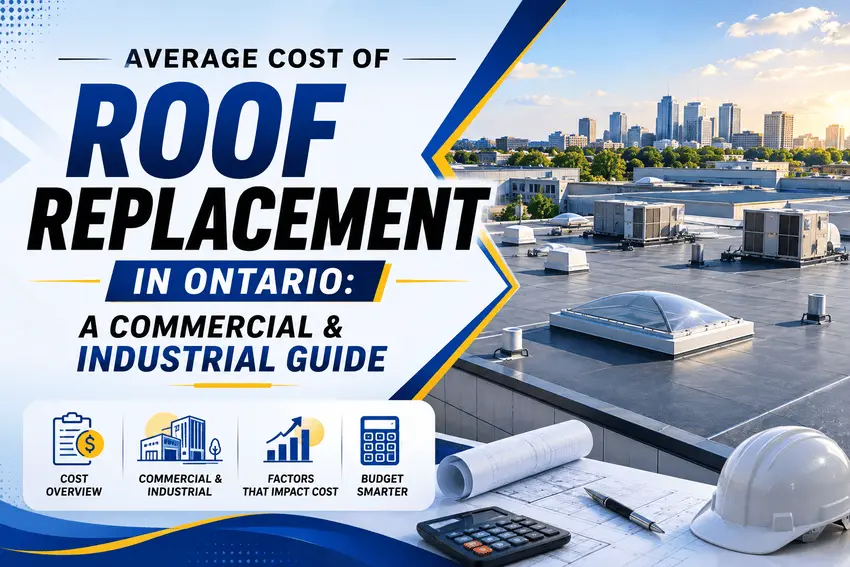
Commercial roof replacement is a significant capital decision for commercial property owners, facility managers, and building operators. When evaluating the average cost of roof replacement, two buildings with similar square footage can receive very different roofing proposals because the cost depends on much more than roof size.
The roofing system, existing roof condition, tear-off requirements, insulation, roof deck, drainage, access, rooftop equipment, labour, and overall project complexity can all affect the final budget.
For commercial and industrial properties in Ontario, understanding these variables before requesting proposals can help you build a more realistic budget and compare contractor quotes based on the complete scope rather than the headline price.
How Much Does Commercial Roof Replacement Cost in Ontario?
There is no single average roof replacement cost for every commercial or industrial building in Ontario, but a preliminary roof replacement planning range may be around $10 to $18 per square foot. This is a budgeting range, not a fixed PWCR quote. A straightforward large roof with good access and limited preparation may fall toward the lower end, while a smaller or more complex project can cost more because of tear-off, wet insulation, damaged decking, drainage work, restricted access, or extensive rooftop equipment.
For example, a 20,000-square-foot commercial roof using this planning range would put the approximate cost of roof replacement at $200,000 to $360,000 for preliminary budgeting purposes. This provides a useful starting point for budgeting while showing why the actual project price can vary based on site conditions and scope.
Actual project costs can vary substantially once the existing roofing assembly is assessed. Hidden moisture, deteriorated insulation, multiple roofing layers, deck damage, drainage deficiencies, and difficult site conditions can all change the scope.
The purpose of an online range is to help with early capital planning, not to replace a site-specific assessment and detailed proposal.
If you are already considering a full replacement, reviewing PWCR’s commercial roof replacement service can also help you understand what a replacement project typically involves.
What Does Commercial Roof Replacement Cost Include?
A commercial roof replacement budget can include much more than the new roofing membrane. The cost of roof replacement can also include tear-off and disposal, insulation, flashing, drainage work, roof deck repairs, labour, equipment, and site safety requirements.
Depending on the project, the scope may include:
- Removal and disposal of the existing roofing system
- New membrane or selected roofing material
- Insulation and related components
- Flashing and edge details
- Parapet work
- Drainage repairs or modifications
- Roof deck repairs
- Labour
- Fall protection and site safety
- Equipment and hoisting
- Material staging
- Cleanup and disposal
The exact scope depends on the existing roof and the proposed replacement system.
A simple commercial building with straightforward access can have a very different cost structure from an industrial facility with multiple roof sections, old roofing layers, rooftop HVAC equipment, and deteriorated deck areas.
This is one reason it is important to understand the difference between a preliminary cost range and a complete commercial roofing proposal.
Commercial Roof Replacement Cost Per Square Foot in Ontario
Roof replacement cost in Ontario is commonly evaluated on a per-square-foot basis because it provides a useful starting point for comparing different buildings and preliminary capital requirements.
However, the number should never be viewed in isolation.
For example, a large distribution facility with an open roof and easy staging may have a lower cost per square foot than a much smaller retail property with restricted access, multiple roof sections, several existing roofing layers, and numerous rooftop penetrations.
Factors That Can Move a Project Toward the Lower or Higher End of a Planning Range
| Cost Factor | Lower Complexity | Higher Complexity |
|---|---|---|
| Roof layout | Large, open, and simple | Small, irregular or multi-section |
| Existing roof | One layer and easy removal | Multiple layers or difficult removal |
| Access | Clear staging and truck access | Restricted access, hoisting or crane requirements |
| Insulation | Limited replacement | Wet, damaged or inadequate insulation |
| Roof deck | Sound and ready for installation | Repairs or replacement required |
| Drainage | Adequate drains and slope | Ponding, blocked drains or upgrades |
| Rooftop equipment | Few units and penetrations | Numerous HVAC units, pipes, vents and hatches |
This is why published roofing prices should be treated as planning references rather than guaranteed project pricing.
Different contractors may also be quoting different scopes. One proposal may include complete tear-off, insulation replacement, drainage work, and deck allowances, while another may not. Comparing the numbers without comparing the scope can therefore create a misleading picture of which proposal is actually more affordable.
What Factors Affect Commercial Roof Replacement Cost?
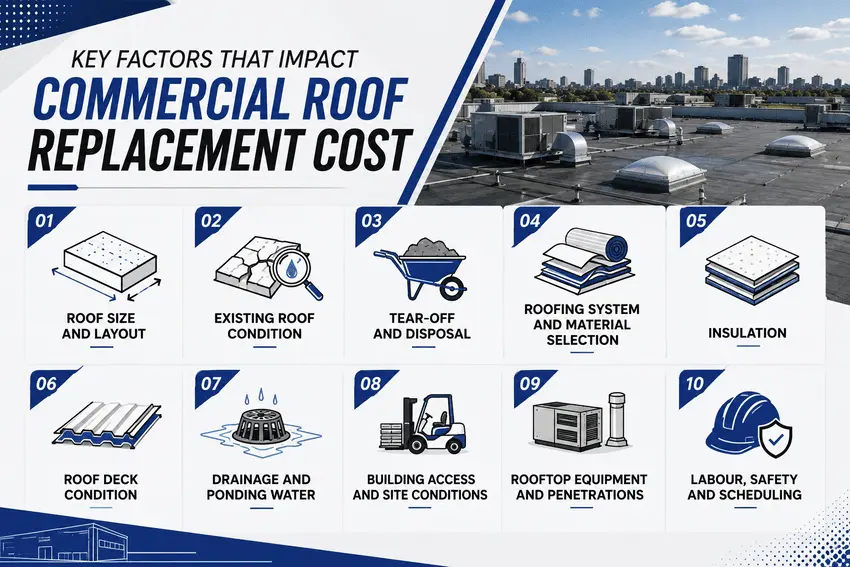
Roof Size and Layout
Total roof area directly affects the amount of material and labour required. However, layout can be just as important as square footage.
A large, continuous roof with straightforward access is generally more efficient to work on than a smaller roof divided into multiple sections with different elevations, parapets, expansion joints, and numerous penetrations.
Larger roofs can sometimes achieve a lower cost per square foot because mobilization, equipment, staging, and other fixed costs are spread across more area.
Existing Roof Condition
The condition of the existing roofing assembly is one of the most important cost variables.
Contractors may need to account for:
- Membrane deterioration
- Recurring leaks
- Moisture infiltration
- Saturated insulation
- Multiple existing roofing layers
- Deteriorated substrate
- Previous repair areas
Some conditions are difficult to confirm until the existing roof is opened, which is one reason preliminary estimates can change during a replacement project.
If the roof is still potentially serviceable, a repair assessment may be worthwhile before committing to full replacement. PWCR’s commercial roof repair service is relevant when the problem may be localized rather than a complete system failure.
Tear-Off and Disposal
Removing an existing roofing system adds labour, equipment, disposal, and project-duration costs.
The scope can become more substantial when multiple roofing layers, difficult-to-remove materials, wet insulation, or heavy roofing assemblies are present.
Tear-off should therefore be clearly detailed in every commercial roof replacement proposal rather than treated as an unconfirmed assumption.
The number of existing layers can also affect whether a project can proceed with a recovery approach or requires more extensive removal. That distinction should be confirmed during the assessment rather than assumed from the roof’s age alone.
Roofing System and Material Selection
Common commercial and industrial roofing systems include:
- TPO
- EPDM
- PVC
- Modified bitumen
- Metal roofing
No single roofing system is universally the cheapest or best option. Selection should consider the building’s use, existing assembly, exposure, expected service life, maintenance requirements, performance needs, and budget.
If you are comparing different roofing systems before requesting a proposal, PWCR’s guide to choosing the right commercial roofing material provides additional context on material selection.
Insulation
Insulation can have a significant effect on replacement cost.
During a roof replacement, the existing insulation should be assessed for moisture, compression, condition, and required thermal performance.
If insulation is saturated or otherwise unsuitable for reuse, replacement may become part of the project scope. New insulation may also be used to improve roof performance or create slope toward drainage points where appropriate.
Because insulation sits below the membrane, its condition is not always obvious from a basic visual inspection.
Roof Deck Condition
The roof deck supports the entire roofing assembly.
Deck problems can result from long-term moisture intrusion, corrosion, rot, or other building conditions. Some deterioration may not become fully visible until the existing membrane and insulation are removed.
A proposal should clearly state how known deck repairs, concealed conditions, allowances, or unit pricing will be handled.
This is particularly important when comparing multiple proposals because a lower initial price may simply reflect a different assumption about the condition of the deck.
Drainage and Ponding Water
Effective drainage is essential to commercial roof performance.
Problems with drains, scuppers, slope, or ponding water may require:
- Drain repairs or replacement
- Scupper modifications
- Tapered insulation
- Slope corrections
- Other drainage improvements
Replacing the membrane without addressing a known drainage problem can leave the underlying cause unresolved.
Persistent ponding can also contribute to premature deterioration of roofing materials and create additional concerns for the building owner.
Building Access and Site Conditions
Access can have a direct impact on labour and logistics.
A building with an open staging area and straightforward material access is generally easier to service than a property requiring:
- Crane or hoist access
- Street staging
- Restricted delivery windows
- Pedestrian protection
- Phased construction
- Work around occupied areas
Occupied commercial and industrial facilities may also require additional coordination to minimize disruption to tenants, employees, inventory, or production operations.
Rooftop Equipment and Penetrations
HVAC units, exhaust fans, vents, skylights, pipes, hatches, conduits, and other rooftop equipment create additional detailing requirements.
The more penetrations and equipment a roof has, the more coordination and labour may be required during replacement.
Mechanical units may also need to be protected, temporarily moved, or coordinated with other trades during portions of the project.
Labour, Safety and Scheduling
Commercial roofing requires planning around fall protection, site safety, material handling, weather, access, and building operations.
Projects scheduled around production shutdowns, tenant operations, or after-hours work may require additional labour and supervision.
Safety requirements should be treated as part of the project scope, not as an optional add-on.
How Roofing Materials Affect Replacement Cost
Different roofing systems have different installation requirements, performance characteristics, and maintenance considerations. For commercial properties with flat or low-slope roofs, flat roof replacement cost can vary based on the roofing system, insulation, drainage, tear-off requirements, roof condition, and site access.
| Roofing System | General Consideration |
|---|---|
| TPO | Common commercial single-ply membrane with heat-welded seams |
| EPDM | Flexible synthetic rubber membrane used across many commercial applications |
| PVC | Durable membrane with particular advantages for some industrial environments |
| Modified Bitumen | Multi-layer system with established commercial applications |
| Metal Roofing | Durable option with different fabrication, fastening, and detailing requirements |
The right system should be selected based on the building and its requirements rather than choosing a material simply because it has the lowest initial price.
Lifecycle expectations, maintenance requirements, building use, exposure conditions, and installation requirements can all influence which system makes the most sense.
Commercial Roof Replacement Cost by Building Size
Building size provides a useful way to visualize the potential financial scale of a project.
Using the illustrative $10–$18 per-square-foot planning range, the calculations below show how roof area can affect preliminary budgeting:
| Roof Area | Preliminary Calculation | Illustrative Planning Range |
|---|---|---|
| 5,000 sq. ft. | 5,000 × $10–$18 | $50,000–$90,000 |
| 10,000 sq. ft. | 10,000 × $10–$18 | $100,000–$180,000 |
| 20,000 sq. ft. | 20,000 × $10–$18 | $200,000–$360,000 |
| 50,000 sq. ft. | 50,000 × $10–$18 | $500,000–$900,000 |
These are hypothetical planning calculations, not actual PWCR project prices or quotations.
A 50,000-square-foot warehouse with a simple roof may have a very different unit cost from a 5,000-square-foot industrial building with restricted access, extensive tear-off, wet insulation, drainage problems, and numerous penetrations.
The table should therefore be used to understand the relationship between roof size and preliminary budgeting, not as a substitute for a contractor’s assessment.
Roof Replacement vs. Roof Repair: Which Makes More Financial Sense?
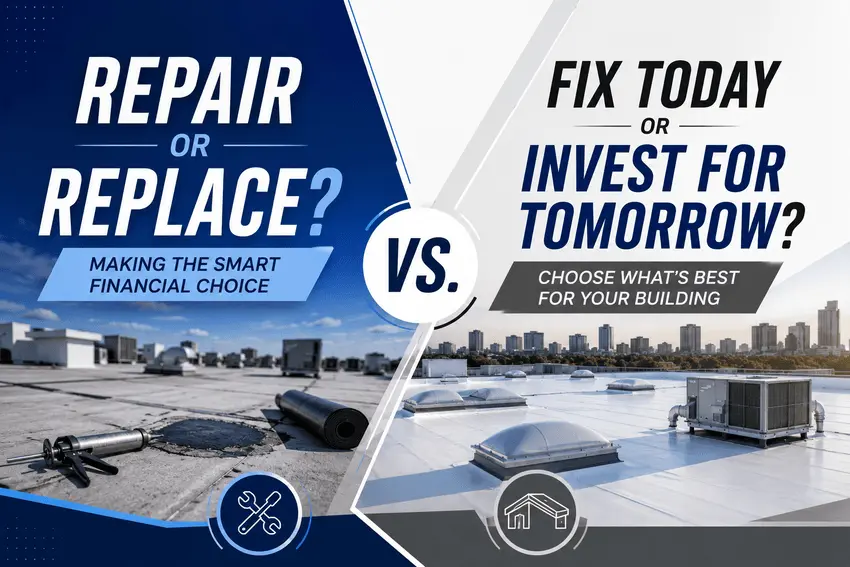
Roof replacement is not automatically the right answer whenever a commercial roof develops a problem.
Repair May Make Sense When:
- Damage is localized
- The existing membrane remains generally sound
- Leaks are limited
- Insulation is dry
- The roof has meaningful useful life remaining
- The underlying problem is repairable
Replacement May Make More Financial Sense When:
- Leaks continue across multiple areas
- Membrane deterioration is widespread
- Insulation is saturated
- Deck damage is extensive
- Repair costs continue to increase
- The roofing system is approaching the end of its useful life
The decision should consider not only the immediate repair cost but also expected remaining service life, future maintenance requirements, operational risk, and the likelihood of recurring problems. Property owners often want to know how much a full roof replacement costs, but an accurate answer requires an assessment of the existing roof, building size, roofing system, tear-off requirements, and site conditions.
For a broader comparison of the decision process, PWCR’s guide on commercial roof failure, repair or replacement is a natural supporting resource.
Hidden Costs That Can Increase a Commercial Roof Replacement Budget
A preliminary estimate may not account for every condition hidden beneath an existing roof.
Potential additional costs can include:
- Damaged or corroded roof deck
- Wet or deteriorated insulation
- Additional roofing layers
- Drain replacement or drainage improvements
- Flashing, edge metal, or parapet repairs
- Structural repairs
- Rooftop equipment coordination
- Difficult staging or hoisting
- Additional disposal requirements
- Safety controls
- Phased construction
- Temporary weather protection
A detailed proposal should distinguish confirmed work from allowances and assumptions. This makes it easier to understand how concealed conditions could affect the final cost.
This is also why property managers should be cautious about choosing a contractor solely because the initial number is the lowest.
How to Budget for a Commercial Roof Replacement
A realistic commercial roof replacement budget should follow a structured process.
The infographic below outlines the key steps to help property owners assess the roof, define the project scope, compare proposals, and build a more realistic replacement budget.
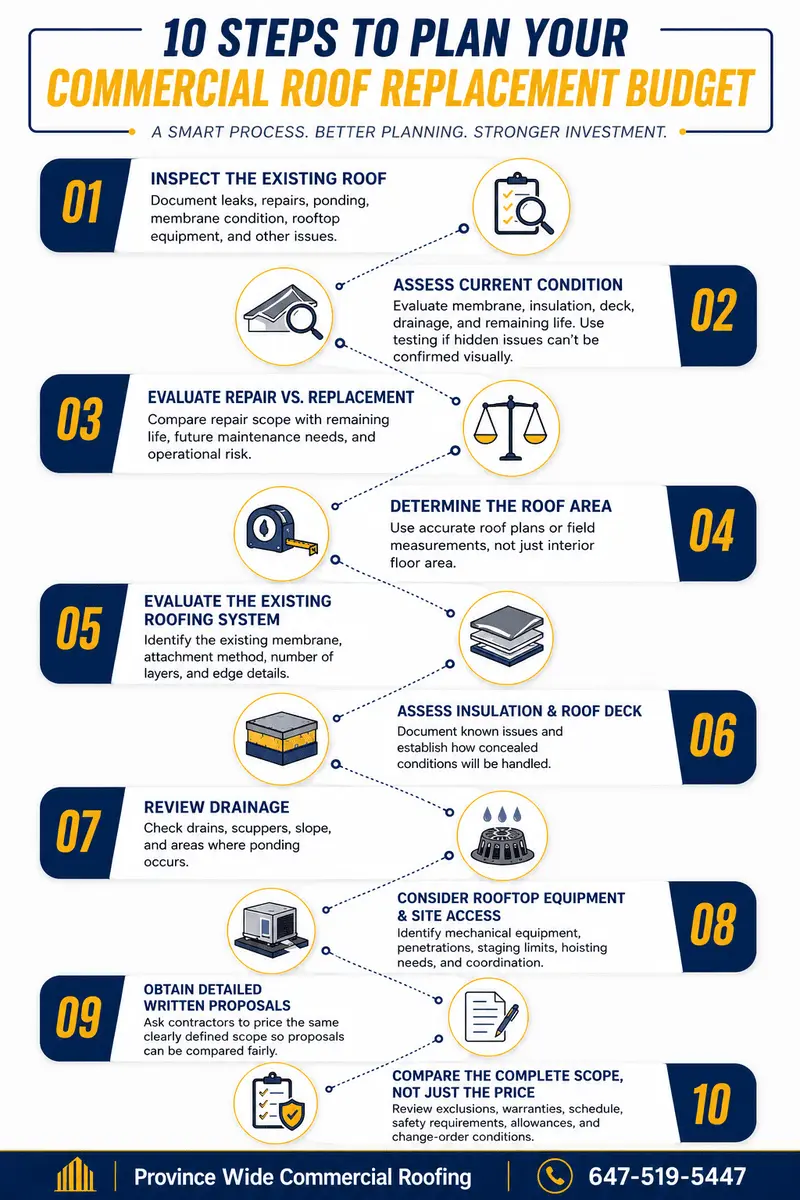
Step 1: Inspect the Existing Roof
Document visible leaks, repairs, ponding, membrane condition, rooftop equipment, and other obvious concerns.
Step 2: Determine the Roof’s Current Condition
Assess the membrane, insulation, deck, drainage, and remaining useful life. Additional testing may be appropriate where visual inspection cannot confirm concealed conditions.
Step 3: Evaluate Repair vs. Replacement
Compare the expected repair scope with the roof’s remaining service life, future maintenance requirements, and operational risk.
Step 4: Determine the Roof Area
Use accurate roof plans or field measurements rather than relying only on the building’s interior floor area.
Step 5: Evaluate the Existing Roofing System
Identify the existing membrane, attachment method, number of layers, and relevant edge details.
Step 6: Assess Insulation and Roof Deck
Document known issues and establish how concealed conditions will be handled during the project.
Step 7: Review Drainage
Check drains, scuppers, slope, and areas where ponding occurs.
Step 8: Consider Rooftop Equipment and Site Access
Identify mechanical equipment, penetrations, staging limitations, hoisting requirements, and coordination needs.
Step 9: Obtain Detailed Written Proposals
Ask contractors to price the same clearly defined scope so the proposals can be compared fairly.
Step 10: Compare the Complete Scope, Not Just the Price
Review exclusions, warranties, schedule, safety requirements, allowances, and change-order conditions before choosing the lowest-priced proposal.
Property owners who are still in the planning stage may also find PWCR’s guide on planning a commercial roof replacement and budgeting useful when preparing for the project.
What Should Be Included in a Commercial Roof Replacement Quote?
A professional commercial roofing proposal should clearly identify:
- Measured roof area
- Existing roof removal and disposal
- Proposed roofing system
- Installation method
- Insulation scope
- Flashing and parapet details
- Drainage work
- Roof deck repair assumptions
- Labour and equipment
- Hoisting requirements
- Safety requirements
- Project timeline
- Work hours and phasing
- Cleanup
- Material and workmanship warranties
- Exclusions and allowances
- Change-order conditions
The lowest quote is not necessarily the lowest-cost option if it excludes work that another contractor has included.
For example, one contractor may include insulation replacement and drainage corrections while another may exclude them. Comparing only the final dollar figure would make those proposals appear directly comparable when they are not.
Compare the complete scope line by line before making a final decision.
How to Avoid Unnecessary Commercial Roof Replacement Costs
No maintenance program can eliminate every roofing problem, but proactive planning can reduce avoidable expenses.
- Schedule regular commercial roof inspections.
- Keep drains and scuppers clear.
- Investigate leaks early.
- Maintain records of repairs and inspections.
- Plan capital expenditure before the roof reaches emergency condition.
- Compare complete scopes when reviewing proposals.
- Select a roofing system appropriate for the building’s use and maintenance requirements.
- Consider long-term drainage and rooftop equipment needs.
- Include commercial roof maintenance in the property’s asset-management plan.
Regular inspections and maintenance can help identify problems before they develop into larger issues involving insulation, decking, or interior building damage.
For property managers looking at ongoing preventive care, PWCR’s commercial roof maintenance service is directly relevant.
When Should You Replace a Commercial Roof?
Warning signs that justify a professional assessment include:
- Recurring leaks
- Widespread membrane deterioration
- Failed seams
- Persistent ponding
- Blistering or bubbling
- Wet insulation
- Damaged roof decking
- Increasing repair frequency
- Repeated storm damage
- A roofing system approaching or exceeding its expected service life
These signs do not automatically mean that full replacement is required.
The extent of deterioration, substrate condition, repair feasibility, remaining service life, and building priorities should all be considered before making the decision.
If you are seeing several of these warning signs, PWCR’s article on signs a commercial roof may need replacement provides additional information on when replacement deserves consideration.
Why a Professional Commercial Roof Assessment Matters
Online calculators and generic per-square-foot estimates can help with early budgeting, but they cannot evaluate the actual conditions of a specific roof.
A professional assessment can help identify:
- Existing roofing layers
- Membrane condition
- Moisture and insulation condition
- Roof deck condition
- Drainage problems
- Flashing and parapet conditions
- Rooftop equipment
- Access and staging limitations
- Building-operation constraints
This information provides a stronger basis for budgeting and helps contractors develop proposals around known conditions rather than assumptions.
It can also make competing proposals easier to compare because each contractor is working from a clearer understanding of the existing roof.