
Winter in the Greater Toronto Area does not announce itself politely. It arrives with weight, compacted snow at loading docks, black ice across drive lanes, and frozen entryways that turn a routine Tuesday morning into a liability incident waiting to happen. For commercial and industrial property managers, the temptation to handle snow removal reactively by calling whoever is available after the storm is a familiar one. It is also one of the more quietly costly decisions made each winter season.
What many businesses underestimate is the cumulative risk and expense embedded in an unmanaged approach. Delayed clearing, insufficient equipment, and inadequate ice control do not just create inconvenience. They generate legal exposure, operational disruptions, insurance complications, and physical damage to facilities. The true cost of in-house or ad-hoc snow management often becomes visible only after something has already gone wrong.
This article is written for property managers, operations managers, and business owners responsible for commercial and industrial sites. It outlines ten concrete benefits of contracting professional snow removal services, benefits that extend well beyond keeping a parking lot passable. For properties that cannot afford any gap in winter readiness, having a clear plan, including access to emergency snow removal services for severe weather events, is part of responsible site management from the outset.
Benefit 1: Protecting Your Business from Slip-and-Fall Liability
Slip-and-fall incidents on commercial properties often result in liability. Canadians report over 9,000 injuries annually, accounting for ice and snow. With 18% of all slip-and-fall injuries are directly attributed to winter conditions on the ground. Under Ontario’s Occupiers’ Liability Act, property owners and managers are mandated by legal duty to stand accountable for the safety of employees, visitors and vendors entering the premises.
A professional contractor keep record of date, time, conditions, and scope of every service event. They document these details in an organized manner that can be used for claiming liability. Property owners use this documentation as a legit proof showcasing adequate care provided to the employees working there. Managing snow removal liability is one of the primary reasons commercial operators move to contracted services. Delayed or incomplete clearing, particularly in high-traffic pedestrian areas, directly increases exposure to costly settlements and reputational damage.
Benefit 2: Keeping Operations Running Without Interruption
For ongoing businesses, a blocked loading dock is a critical operational failure. Even a few hours of restricted access can halt production cycles and disrupt delivery schedules. Snow clearing for business should not interrupt business schedules and should be continued for regular operations activities.
Professional contactors identify the critical points in advance, check with fire routes, and dock approaches. They pay attention to these points during and after every storm event. On the contrary, an in-house team doesn’t really apply a coordinated strategy beforehand. They help with preventive measures once the problems have already arisen. A commercial snow removal contractor applies a planned sequence of actions that keeps the site safe and accessible throughout.
Benefit 3: Access to Commercial-Grade Equipment
The gap between commercial-grade snow removal equipment and what most in-house teams operate is substantial. A major accumulation event demands front-end loaders, multi-blade plow trucks, and high-capacity spreaders capable of handling large surface areas efficiently. Small machinery compact tractors, consumer-grade snowblowers, and hand-operated equipment fall behind quickly when accumulation is heavy, leaving critical access zones compromised for hours longer than necessary.
Professional contractors invest in fleets scaled for the commercial and industrial environments they serve. Equipment is pre-positioned and maintained throughout the season, not scrambled together after a storm warning. This infrastructure investment represents a shared overhead across the contractor’s client base, delivering the capability of a full commercial snow management operation at a fraction of what any single property would spend to replicate it. For large industrial compounds and multi-building campuses, the difference in speed and coverage between appropriate equipment and inadequate equipment is the difference between a site that is open on time and one that isn’t.
Benefit 4: 24/7 Availability When Storms Don’t Follow Business Hours
The most operationally damaging storms or weather situations give rise during the non-functional hours of the in-house maintenance team. A site with a risk of receiving six inches of overnight snowfall cannot wait till 6. a.m for clearance. Professional contractors offering 24/7 snow removal services respond to after-hour catastrophes.
The crews remain active during storm events and help to tackle real-world problems immediately. Consistent after-hours availability is what separates a professional snow removal team from any ad-hoc arrangement.
Benefit 5: Faster Response During Severe Weather Events
Rapid storm response is not the same as standard snow maintenance. During critical snow events, routine clearing schedules may not arrive on time, leading to traffic access point backlogs. Professional snow removal contractors maintain dispatch protocols that are specifically designed for severe conditions. The crowd visits the critical areas and develops site-specific plans before the season begins.
This is highly beneficial for manufacturing facilities that operate overnight shifts or distribution hubs handling time-sensitive freight. This is when the emergency snow removal services offer measurable operational protection. If you choose to rely on ad-hoc calls during an active storm, your operations face the risk of delayed response times and disruptions.
Benefit 6: Consistent Ice Control, Not Just Snow Plowing
Snow plowing addresses visible accumulation. It does not address black ice, refreezing melt water, or the polished, compacted surfaces that develop in shaded areas after each freeze-thaw cycle. For commercial and industrial sites where pedestrian and vehicle traffic is continuous, ice control for commercial properties is as important as any plowing service, arguably more so, because ice is often invisible until someone has already fallen.
Professional contractors apply commercial-grade de-icing agents and treated salt to high-risk surfaces as an integrated part of their service scope. Targeted application in high-traffic zones, such as dock approach ramps, pedestrian walkways, main entrances, and stairwells, reduces incident risk significantly compared to coverage that treats ice as an afterthought. Ice management also protects pavement integrity over time, as repeated freeze-thaw penetration into untreated surfaces degrades asphalt and concrete faster than seasonal wear alone. Comprehensive winter management is not a plowing contract with ice control added as an option; it is a service that treats both hazards as inseparable.
Benefit 7: Reduced Long-Term Costs Compared to In-House Management
The cost estimate for managing snow in-house is categorized via a direct comparison. Like buying or renting equipment for the season, fuel costs, regular maintenance, and paying staff overtime. And also dealing with team shortages during storms or sick days, with the added risk when snow clearing isn’t consistent. Reactive approaches include calling a contractor when the storm has already arrived.
These services are more expensive and do not ensure a timely visit. Professional snow removal service contracts divide their cost structure as per staff, insurance and equipment across multiple properties. This is why they operate more efficiently at a lower cost per site. On the contrary, if a commercial property tries to handle snow removal on its own, they have to bear the expense of these costs alone.
Benefit 8: Protecting Roof Structures and Building Envelope Integrity
Flat commercial roofs, the dominant form across warehouses, distribution facilities, and industrial buildings throughout Ontario, are structurally vulnerable to snow load accumulation in ways that pitched roofs are not. Wet, heavy snow and repeated freeze-thaw cycles can push roof systems beyond their designed load capacity, stressing trusses, joists, and deck connections while accelerating membrane deterioration and drainage failures. What appears to be a manageable snow layer can represent several tonnes of unevenly distributed weight, particularly after multiple storms have compressed previous accumulation.
This is where the contractor’s background matters. A snow removal contractor with commercial roofing expertise understands the structural thresholds involved and knows where to clear, in what sequence, and how to remove snow without introducing additional risk to membrane surfaces or drainage systems. PWCR’s dual specialization in commercial roofing and snow removal positions its crews to assess roof conditions with an understanding that most landscaping-based or general-purpose contractors simply do not have. For any commercial property manager overseeing flat-roof buildings, this combination of knowledge is a structural safety consideration.
Benefit 9: Compliance with Municipal and Site Safety Standards
Commercial properties across the GTA operate under municipal bylaws that impose specific obligations for the timely clearing of sidewalks, fire lanes, pedestrian access routes, and parking areas. Requirements vary by municipality, but the general standard is consistent: access points must be cleared to bare pavement or a non-slippery surface, and ice must be treated with appropriate materials, within defined timeframes after snowfall ends. Non-compliance generates fines, creates bylaw enforcement records, and can complicate insurance renewals and claims.
Professional contractors operate with a working knowledge of local clearing standards and priority access concepts applicable to commercial sites in their service area. This operational awareness means that winter site safety obligations are being managed by someone who understands the regulatory context. For properties in multiple jurisdictions, or with site configurations that include regulated access routes such as fire lanes, contracted clearing with documented service logs is the only defensible approach from a compliance standpoint.
Benefit 10: One Less Critical Operation to Manage Internally
In-house snow removal management significantly diverts the attention of operations managers. This situation causes the business to suffer during these acute situations. A professional commercial snow removal contractor removes that burden entirely. Dispatch, equipment deployment, staffing, service sequencing, and post-event documentation are handled by the contractor as a complete managed service.
Reliable contractors communicate proactively before, during, and after events so property managers always have a clear picture of site status without having to chase it down. For operations managers overseeing multiple buildings or large-footprint sites, contracting this function to a qualified professional is not a convenience it is a sound delegation of a high-risk operational responsibility.
When to Reach Out to a Professional Snow Removal Contractor
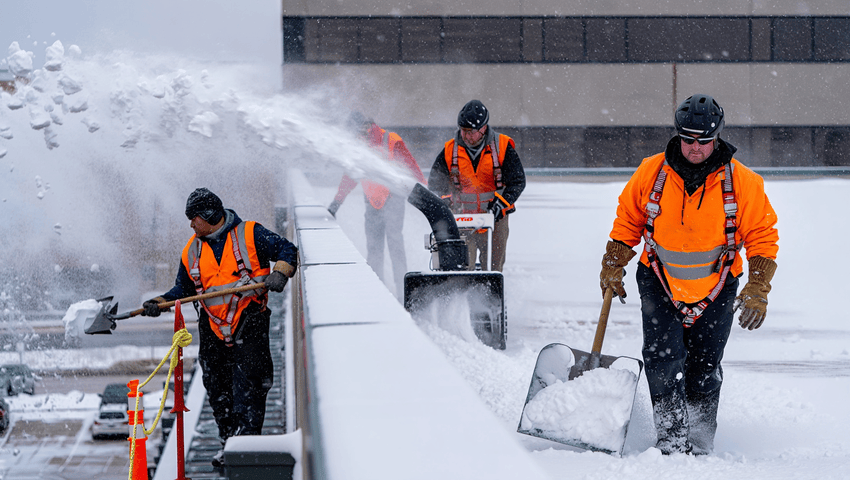
The most important thing to understand about professional snow management is this: the time to establish a contractor relationship is before a storm threatens your site, not during one. Mid-storm calls to unfamiliar contractors almost always result in delayed response, higher per-event costs, and service delivered by crews with no prior knowledge of your site’s access priorities or structural considerations.
There is a meaningful distinction between planned seasonal service contracts and on-demand emergency response, and the most effectively protected commercial sites use both. A seasonal contract establishes the baseline clearing schedule and site plan. Emergency response capacity addresses the escalating events, significant accumulation events, rapid freezing conditions, or storms that overwhelm standard clearing timelines, where the difference between a contracted relationship and an ad-hoc call becomes most visible.
Common timing mistakes include waiting until snowfall has already compacted before initiating clearing, and relying on a landscaping contractor not equipped or staffed for the scale and speed that snow removal for commercial properties demands. PWCR’s emergency snow removal services are designed specifically for commercial and industrial sites that cannot afford an operational gap when conditions escalate.
Conclusion
Investing in a trusted snow removal contractor dedicated to commercial buildings will help you prepare for risk management before time. Aside from benefits, it helps to address legal exposure, regulatory compliance and structural integrity, which are critical parameters for running businesses. Faiclity owners who proactively approach winter preparation are better positioned to minimize liability claims. Winter in Ontario does not reward improvisation. Hence, managing it reactively may not ensure the protection needed for your operations or site.