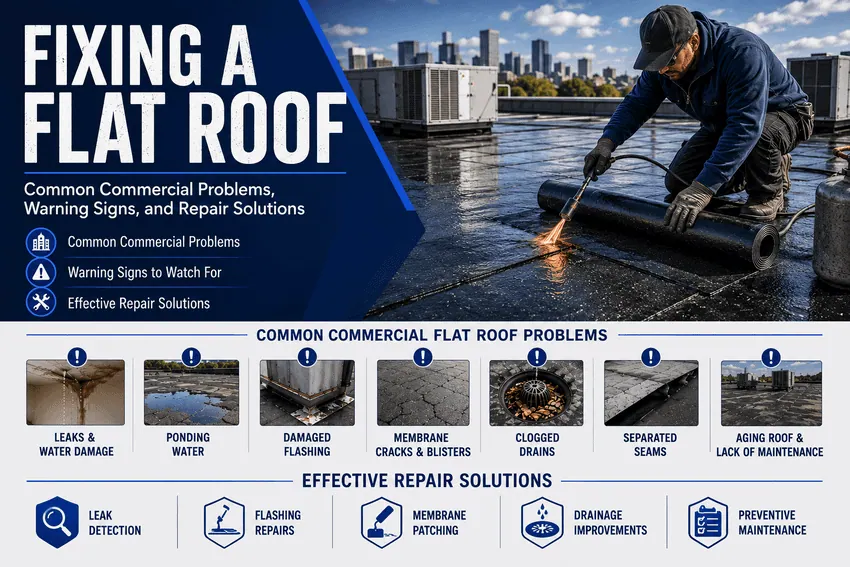
Fixing a Flat Roof: What Commercial Property Owners Need to Know
If you manage or own a commercial property in Toronto or the Greater Toronto Area, your flat roof is one of the most important and vulnerable parts of your building. Right now, the cost of ignoring roofing problems has never been higher. Material costs are up, skilled labour is in demand, and increasingly severe weather patterns across Ontario are placing greater stress on commercial roofing systems than in previous decades.
One reality roofing professionals encounter regularly: most commercial flat roof repairs that turn into emergency calls started as small, manageable issues. Ponding water that nobody checked on. A seam that separated gradually over one winter. Flashing around an HVAC unit that lifted slightly and let moisture creep in for months before anyone noticed. By the time water stains become visible on the ceiling of your warehouse or retail space, the hidden damage is almost always worse than what you can see.
Property owners searching for answers on how to fix a leaking flat roof often discover the hard way that finding the visible drip is the easy part. Tracing it back to the actual entry point on the roof, choosing the right repair method, and making sure the fix lasts through Ontario winters is where professional experience genuinely matters.
The good news? Most of these problems are entirely preventable. And those that are not preventable are far less expensive to fix when caught early.
This guide draws on over two decades of hands-on commercial roofing experience across Southern Ontario to walk you through everything you need to know about fixing a flat roof: the causes, the warning signs, the repair options available today, and how to make the right decision between repair and full replacement. Whether you are a facility manager, a property management company, a warehouse operator, or a business owner responsible for a retail plaza, this information will help you protect your investment and keep your operations running without disruption.
What Causes Commercial Flat Roof Problems?
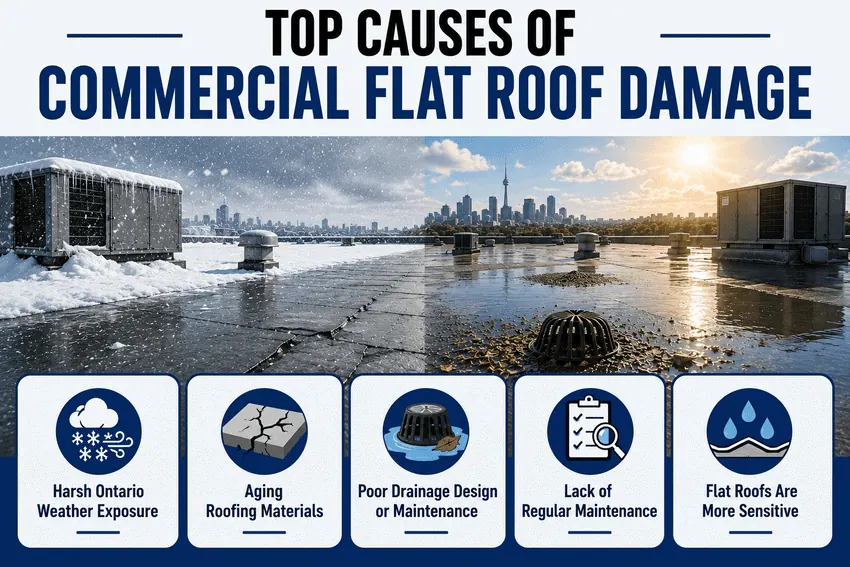
Commercial flat roofs are not actually perfectly flat. They are designed with a very slight slope to move water toward drainage points. But that subtle engineering makes them far more sensitive to neglect than a sloped residential roof. Here is why problems develop so frequently on commercial properties:
Harsh Ontario Weather Exposure
Toronto and the surrounding GTA experience one of the most punishing weather cycles for flat roofing materials in North America. Winters bring heavy snow loads, freeze-thaw cycling, and ice damming. Summers deliver intense UV radiation and heat that degrades membranes over time. The Canadian Roofing Contractors Association (CRCA) has extensively documented how Ontario’s freeze-thaw cycle forces building materials to expand and contract repeatedly, stressing seams, lifting flashings, and cracking older membranes season after season.
Commercial roofs in winter face particular challenges. When water penetrates even a tiny opening, freezes, and expands, that opening becomes noticeably larger. By spring, what started as a hairline crack can be a visible gap. This cycle repeats each season until someone addresses it.
Aging Roofing Materials
Commercial flat roofs typically last anywhere from 15 to 30 years, depending on the membrane type, installation quality, and how consistently the roof has been maintained. As roofing systems age, seams become more brittle, coatings thin out, and the membrane loses the flexibility it needs to handle thermal movement. Older systems are also more likely to have had multiple patch repairs that created irregular stress points across the roof surface.
Poor Drainage Design or Maintenance
Flat roofs depend entirely on drainage systems working as designed. When roof drains become blocked with debris such as leaves, gravel, bird nesting material, or windblown garbage, water has nowhere to go. It accumulates, increases dead load on the roof structure, and eventually finds its way through the membrane, seams, or flashings.
In some cases, the drainage issue is not maintenance-related at all. Roofs that were not originally designed with adequate slope, or buildings that have settled slightly over decades, can develop low spots where water always collects regardless of how clear the drains are.
Lack of Regular Maintenance
This is the most common and most avoidable cause of flat roof problems. Commercial roof maintenance is mostly a matter of regular inspection, keeping drains clear, and addressing small issues before they grow. Yet many property owners go years without having their roof professionally inspected, especially if the interior appears dry and there are no obvious signs of trouble.
The problem with this approach is that flat roof damage is largely invisible from the ground until it is advanced. A small membrane blister, a failing sealant bead, or a slightly separated seam does not announce itself. It quietly lets moisture migrate through the roofing assembly until the insulation is saturated and the damage is extensive.
7 Common Commercial Flat Roof Problems That Lead to Costly Repairs
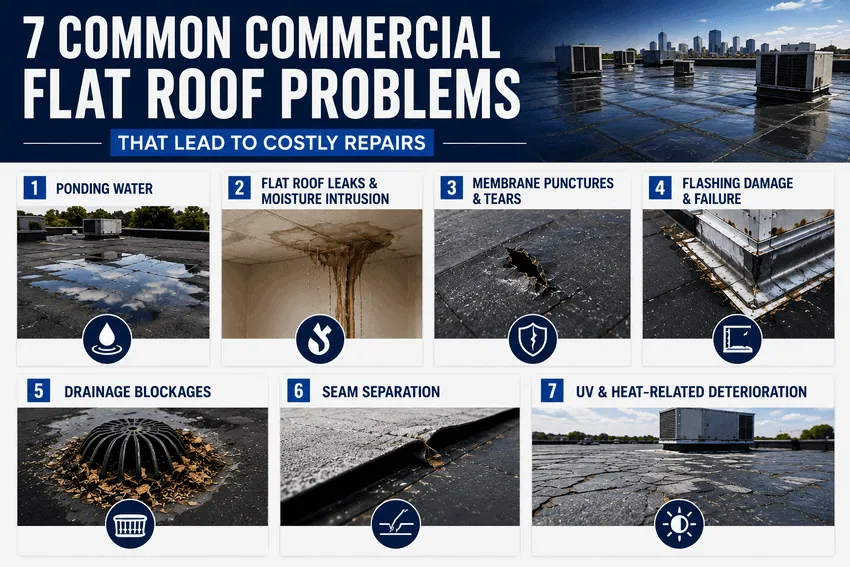
Understanding what goes wrong with commercial flat roofs is the first step toward protecting your building. These are the issues that roofing contractors encounter most frequently on commercial properties across Toronto, Mississauga, Brampton, Oakville, and the GTA.
1. Ponding Water
Ponding water is standing water that remains on the roof surface for more than 48 hours after rainfall. It is one of the most widespread and damaging problems affecting commercial flat roofs. When water pools consistently in the same area, it begins to saturate the roofing membrane, breaks down the material over time, and eventually penetrates through to the insulation below.
The weight of standing water adds significant dead load to the roof structure. Over time, this can cause structural deflection where the roof decking sags slightly, which creates an even larger low spot, which holds even more water. The problem compounds itself.
Ponding also creates ideal conditions for algae, moss, and organic growth. These organisms further break down the membrane surface and can cause fasteners and seams to deteriorate faster than they would otherwise.
If water is still sitting on your roof two days after a rainstorm, that is a drainage issue that needs professional attention before it becomes a repair emergency.
2. Flat Roof Leaks and Moisture Intrusion
Despite being the most common complaint from commercial property owners, roof leaks are often misunderstood. Most experienced commercial roofing contractors will tell you that the majority of flat roof leaks do not actually originate in the middle of the field membrane. They start at penetrations, flashing details, seams, and drainage connections. This is consistent with what the CRCA identifies as the primary water entry points in low-slope roofing systems.
Water that appears on your ceiling directly below a rooftop HVAC unit likely entered through the flashing around that unit, not through the membrane itself. Water staining along a wall might trace back to failed perimeter flashing rather than a membrane puncture.
Moisture intrusion is particularly tricky because water migrates laterally through saturated insulation before it appears anywhere visible inside the building. A leak that shows up in one corner of your warehouse may have entered the roof assembly ten or fifteen feet away. This lateral migration is why professional leak detection using infrared thermal scanning is far more reliable than a visual inspection alone.
3. Membrane Punctures and Tears
The waterproofing membrane is the primary line of defence for any commercial flat roof, whether it is a single-ply system like TPO, PVC, or EPDM, or a multi-layer system like modified bitumen or BUR. When that membrane is punctured or torn, the protection is compromised immediately.
Membrane damage comes from HVAC technicians or other tradespeople walking on unprotected roof areas, windblown debris creating impact damage, heavy hail events, or simply the natural brittleness that comes with an aging membrane exposed to years of UV radiation and thermal cycling.
Small punctures that might seem insignificant can allow water to enter the roofing assembly every time it rains. Over months, the insulation below becomes saturated, the roof deck begins to deteriorate, and what could have been a simple patch repair becomes a much more extensive and expensive intervention.
4. Flashing Damage and Failure
Flashing is the metal or membrane material used to seal the edges of a flat roof at parapets, walls, curbs, skylights, vents, and penetrations like HVAC equipment, pipes, and drains. It is the detailing that makes a flat roof system watertight at its most vulnerable transition points.
Flashing failure is extremely common on commercial roofs, especially those that are more than 10 to 15 years old. The metal expands and contracts with temperature changes, the sealant dries and cracks, and over time the bond between flashing and membrane weakens. On GTA roofs, the repeated freeze-thaw cycles of Ontario winters accelerate this deterioration significantly.
When flashing fails, water has direct access to the building envelope at the roof edge. The resulting leaks can appear inside the building as wall staining or moisture in the ceiling near exterior walls, symptoms that are often misattributed to window failures or exterior cladding issues.
5. Drainage Blockages
Even a perfectly installed flat roof with ideal slope will develop problems if the drainage system is not maintained. Roof drains, scuppers, and gutters that are blocked with organic debris, gravel wash-off, or accumulated sediment stop performing their function entirely.
Blocked drainage does not just cause ponding. The weight of debris and standing water can physically distort the membrane around drain bowls, compromising the watertight seal where the membrane integrates with the drain hardware. Replacing a roof drain on a commercial building is a more complex and expensive operation than clearing a blocked one preventively.
6. Seam Separation
Every commercial flat roof has seams where sections of membrane material are overlapped and bonded together, either with heat welding for TPO and PVC systems, adhesive for EPDM, or torch-applied heat for modified bitumen. These seams are, by definition, the weakest points in any membrane system.
Over time, seam bonds weaken. Thermal movement stresses the overlap repeatedly with each temperature swing. UV degradation affects the outer surface of the membrane, including at seam edges. On older roofs, adhesive seams can simply dry out and separate.
For warehouses in Ontario with large TPO or EPDM roof systems, periodic seam integrity testing is a worthwhile investment as the membrane approaches the midpoint of its service life.
7. UV and Heat-Related Deterioration
Ontario summers deliver significant UV intensity, and commercial flat roofs are in full, unshaded sun exposure for most of the day. UV radiation breaks down roofing materials at the molecular level over time, making membranes brittle, drying out sealants and caulking, and fading protective coatings.
Heat is equally damaging. Dark-surfaced membranes on commercial roofs can reach extremely high surface temperatures on hot summer days. This thermal stress contributes to blistering, where moisture trapped beneath the membrane turns to vapour and pushes up against the surface, creating raised bubbles that indicate a failed bond between the membrane and the substrate.
This is one of the reasons why TPO roofing with its white, reflective surface has become so widely adopted for commercial applications in Southern Ontario.
Quick Reference: Problems, Warning Signs, and Repair Solutions
| Problem | Key Warning Sign | Recommended Solution |
| Ponding Water | Standing water 48+ hrs after rain | Tapered insulation, drain addition |
| Flat Roof Leaks | Interior ceiling stains | Professional leak detection, targeted repair |
| Membrane Punctures | Visible tears, blistering | Membrane patching or section replacement |
| Flashing Failure | Wall staining, lifted metal edges | Flashing removal and replacement |
| Drainage Blockage | Debris buildup, slow drainage | Drain clearing, drainage improvements |
| Seam Separation | Open seam gaps, recurring leaks | Heat welding or adhesive re-bonding |
| UV Deterioration | Chalky surface, surface cracking | Roof coating application |
6 Warning Signs Your Commercial Flat Roof Needs Immediate Repair
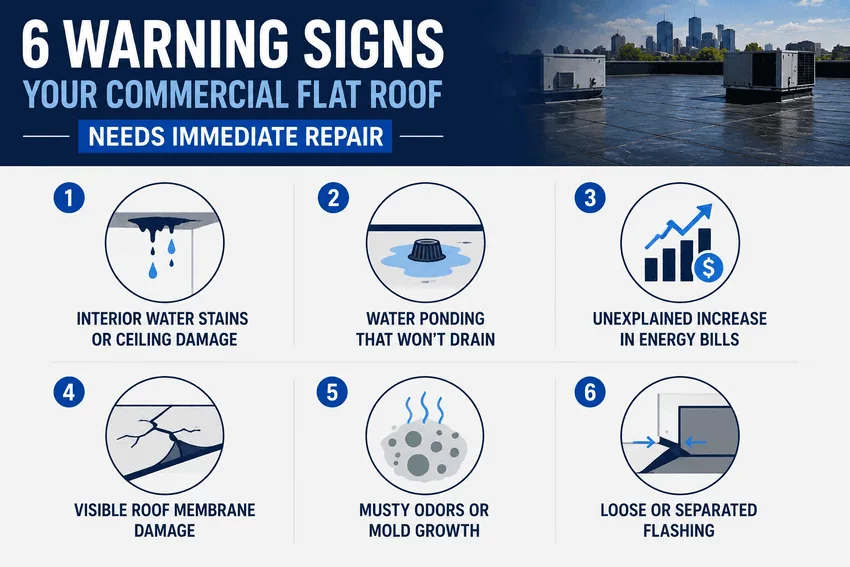
You do not need to be a roofing professional to notice the early warning signs of flat roof problems. These signals tell you it is time to call for a commercial roof inspection before a small problem becomes a costly one.
- Interior water stains or ceiling damage. This is the most obvious sign, and by the time it appears, the problem is already well developed. Water stains on ceiling tiles, discolouration of interior drywall, or bubbling paint along interior walls all indicate active moisture intrusion. The actual entry point on the roof is almost always farther away from where the water appears inside. Do not wait to see if the stain grows.
- Standing water more than 48 hours after rain. If you walk the roof and find water still sitting in the same areas two days after the last rainfall, you have a drainage problem. Document where the ponding occurs and roughly how deep the water gets. This information is useful for the roofing contractor who will assess the drainage solution.
- Rising energy costs without an explanation. When insulation becomes wet, it loses nearly all of its thermal resistance. The result is higher heating costs in winter and higher cooling costs in summer, often significant enough to show up in monthly utility bills. If your energy bills have climbed noticeably without a change in occupancy or operations, it is worth having the roof insulation assessed alongside a maintenance inspection.
- Visible membrane damage during a roof walk. Blistering or bubbling of the membrane, cracks or splits in the material, areas where the surface has become granulated or chalky, lifting at seams or edges, or visible punctures should all be investigated promptly. Even small membrane defects should not be left unaddressed through another Ontario winter.
- Mold, mildew, or persistent moisture odours. If occupants are reporting musty odours or you are finding mold growth on interior surfaces near the roof line, moisture has already penetrated the building envelope. This is a health and safety concern that requires urgent attention.
- Flashing pulled away from walls or curbs. Any visible gap between flashing and the surface it is meant to seal is an active water entry point that warrants immediate professional assessment.
How to Fix a Leaking Commercial Flat Roof: Step-by-Step Process
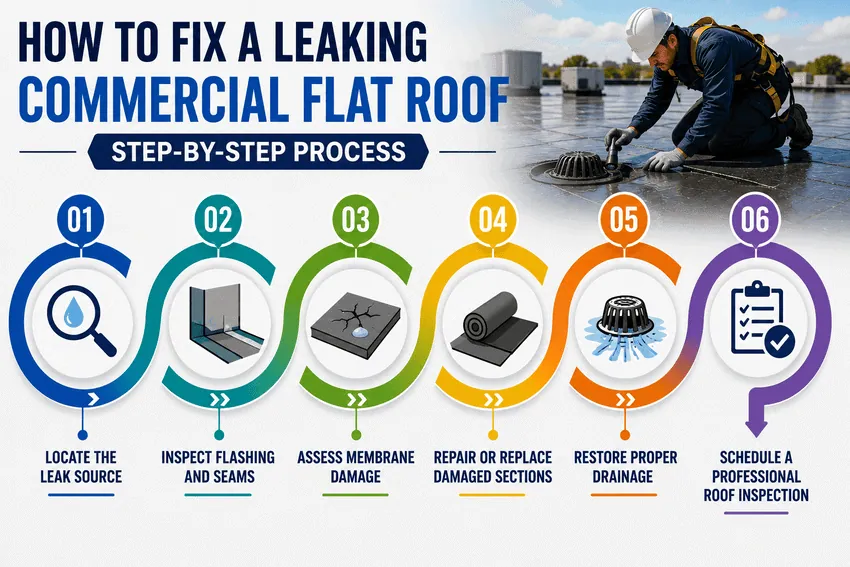
When commercial property owners search for information on how to fix a leaking flat roof, they are often looking for a quick solution to stop water from entering the building. In reality, effective flat roof repair is a systematic process. Simply patching the area where water appears inside rarely solves the underlying problem. A successful repair starts with identifying the true source of the leak and addressing the conditions that allowed it to develop in the first place.
1. Locate the Leak Source
The first step is identifying where water is actually entering the roofing system. This is often more complicated than it appears. Water can travel through insulation layers and structural components before becoming visible inside the building. A stain on a ceiling tile may be several feet away from the actual point of entry on the roof. Professional inspections often use moisture detection methods and infrared scanning to accurately trace the source.
2. Inspect Flashing and Seams
Once the leak area has been identified, all nearby flashing details, seams, penetrations, and roof transitions should be carefully inspected. Flashing around HVAC equipment, vents, parapet walls, skylights, and drainage components are among the most common leak locations on commercial flat roofs. Even a small separation in a seam or flashing detail can allow significant moisture intrusion over time.
3. Assess Membrane Damage
The condition of the roofing membrane should then be evaluated. Punctures, tears, blistering, cracking, and UV deterioration can all compromise the waterproofing performance of the roof. Determining whether the damage is isolated or part of a larger deterioration pattern helps guide the most appropriate repair strategy.
4. Repair or Replace Damaged Sections
Once the source and extent of damage are confirmed, the affected area can be repaired. Depending on the roofing system and severity of the issue, this may involve membrane patching, seam re-bonding, flashing replacement, or localized section replacement. The goal is not only to stop the current leak but also to restore the long-term integrity of the roofing system.
5. Restore Proper Drainage
Many recurring roof leaks are connected to drainage problems. Ponding water places ongoing stress on membranes, seams, and flashing details. If standing water remains on the roof for more than 48 hours after rainfall, drainage improvements such as clearing blockages, adding drains, or installing tapered insulation may be necessary to prevent future problems.
6. Schedule a Professional Roof Inspection
After repairs are completed, a professional inspection helps verify that all issues have been properly addressed. It also provides an opportunity to identify other developing problems before they become costly emergencies. For most commercial properties in Ontario, regular inspections remain one of the most effective ways to extend roof life and reduce long-term repair costs.
How to Fix a Leaking Commercial Flat Roof: Repair Solutions That Work
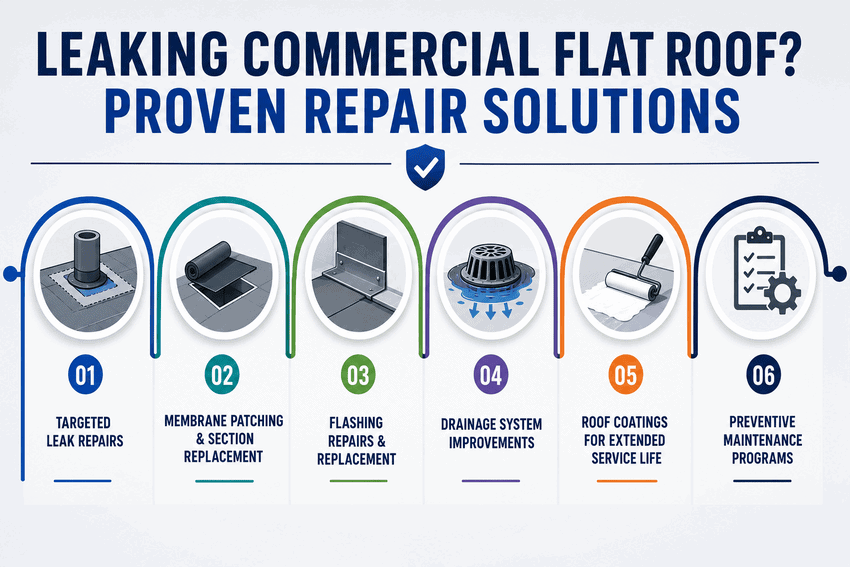
Once a problem is identified, the appropriate repair solution depends on the type of damage, the extent of the affected area, the age of the roof, and the membrane system in place.
Targeted Leak Repairs
For isolated leaks traced to a specific penetration, flashing failure, or small membrane defect, a targeted repair is the most cost-effective solution. The affected area is cleaned and prepared, the damaged material is removed, and a compatible patch or new flashing is installed. On a well-maintained roof, a properly executed flat roof leak repair will last for many years.
The key is accurate leak source identification. Applying a patch to where water appears inside the building, rather than where it is actually entering the roof assembly, is one of the most common and costly mistakes in commercial roof repair. A professional repair process always starts with proper diagnosis.
Membrane Patching and Section Replacement
For moderate membrane damage such as punctures, tears, or areas of blistering limited in extent, membrane patching is a proven and durable solution. The damaged section is cut out, the substrate is assessed and repaired if necessary, and a new piece of compatible membrane material is installed with proper adhesion and seam bonding.
For TPO and PVC systems, patches are heat-welded to create a bond as strong as the original membrane. For modified bitumen systems, torch-applied or cold-adhesive patching is used. Material compatibility is critical. Using the wrong patch material on a particular membrane type results in a bond that fails prematurely.
Flashing Repairs and Replacement
Damaged or deteriorated flashing can typically be repaired or replaced without disturbing the main field of the roof membrane. Old sealant is removed and replaced. Lifted metal flashing is re-secured and re-sealed. Where flashing has failed structurally, new metal or membrane flashing is fabricated and installed.
Sheet metal fabrication for custom flashing and metal fabrication work is a specialized skill. The flashing needs to fit precisely around the irregular geometry of HVAC curbs, parapets, and roof-to-wall intersections on commercial buildings. Poorly fabricated flashing is one of the leading causes of recurring flat roof leaks.
Drainage System Improvements
Blocked drains can often be cleared as part of a regular maintenance visit. But when drainage problems are structural, such as an inadequate number of drains for the roof area or drains positioned away from the actual low points of the roof, more significant intervention is required.
Tapered insulation systems can be installed over an existing roof to create proper slope toward drain locations, eliminating ponding without requiring a full tear-off. Additional drains or scuppers can be added where the roof consistently holds water. These drainage improvements address the underlying cause of multiple recurring problems at once.
Roof Coatings for Extended Service Life
Roof coatings including silicone, acrylic, or polyurethane can add years to the service life of an aging but structurally sound commercial flat roof. Applied over a properly prepared and repaired membrane surface, coatings seal minor surface defects, provide a reflective surface that reduces thermal stress, and restore UV protection. Learn more about how commercial roof coatings can save you money over the long term.
The critical prerequisite for any coating system is that the existing membrane must be structurally sound and dry. Applying a coating over wet or failing insulation locks moisture into the assembly and creates a much larger problem.
Preventive Maintenance Programs
The most cost-effective approach to managing a commercial flat roof over its full service life is a structured preventive maintenance program. Twice-yearly inspections, ideally in spring and fall, combined with drain clearing, minor sealant renewal, and early-stage patching of any developing issues keep a commercial roof performing reliably and push replacement further into the future.
PWCR’s commercial roof maintenance programs are designed specifically for Ontario commercial properties, with inspection schedules calibrated to catch post-winter damage before spring rains arrive and pre-winter preparation before the first freeze.
Commercial Roof Repair vs Replacement: Which Option Makes Sense?
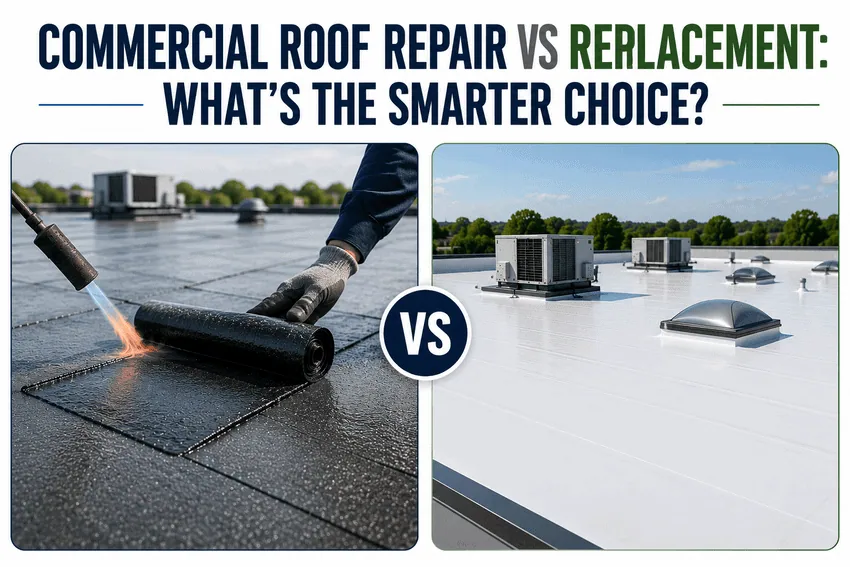
One of the most important decisions a commercial property owner faces is whether a flat roof repair makes financial sense, or whether the roof has reached the point where continued repairs are throwing good money after bad.
Factors That Support Repair
A commercial flat roof is a strong candidate for repair rather than replacement when the majority of the membrane is in sound condition, the roof deck shows no significant structural deterioration, the damage is localized to specific areas rather than distributed across the whole roof, and the roof has meaningful service life remaining.
For example, a 12-year-old TPO roof with a few areas of failed flashing and a membrane puncture near an HVAC unit is an excellent candidate for targeted repair. The system has significant remaining life, the damage is identifiable and limited, and a well-executed repair will protect the building for many more years.
Factors That Point Toward Replacement
When repairs are the right answer for isolated problems, they are the wrong answer for systemic deterioration. Signs that commercial roof replacement is likely more cost-effective include a roof that is well beyond the midpoint of its expected service life, moisture damage that is extensive and distributed across large portions of the roof, repairs that have been made repeatedly to the same areas without lasting resolution, and roof deck deterioration that affects structural integrity.
The cost to replace a commercial roof in Toronto reflects current material and labour costs, but when you factor in the cost-per-year-of-service calculation, a high-quality replacement often provides better long-term value than continued repairs on a failing system.
An experienced contractor will never push you toward replacement when repair is the appropriate solution. Knowing when to hire a certified flat roofing contractor to make that assessment objectively is critical to sound building management. For a detailed breakdown, read our guide on commercial roof failure: repair or replace.
Emergency Repairs
Some flat roof situations require immediate action regardless of the long-term replacement question. Active leaks entering a building, severely compromised drainage during heavy rainfall, or membrane damage following a hail event or major storm all qualify for emergency commercial roof repair. Emergency repairs stop active damage, protect the building interior, and buy time for a properly planned and budgeted comprehensive repair or replacement project.
If you are dealing with an urgent flat roof situation in Toronto or the GTA, PWCR’s emergency roofing team is available to respond quickly and implement the right temporary or permanent solution.
Why Fixing a Flat Roof Early Saves Thousands in Repair Costs
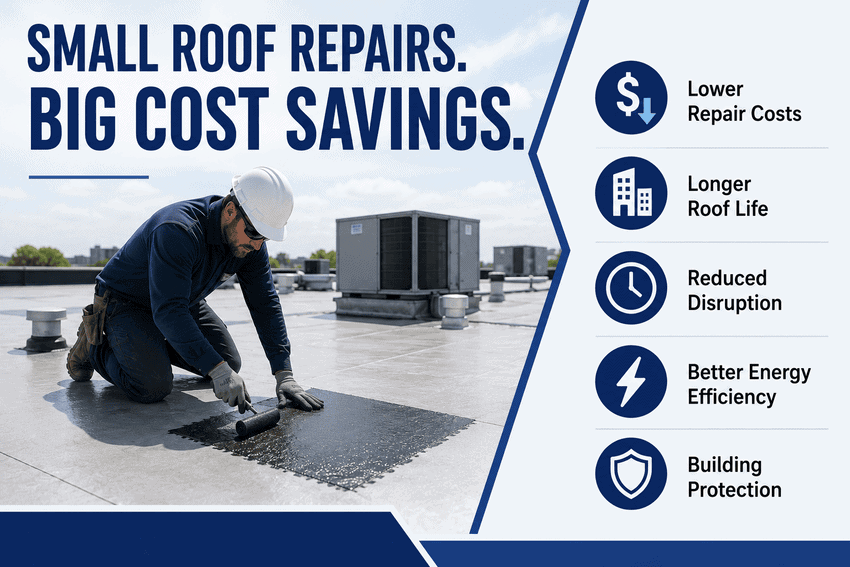
The business case for proactive flat roof maintenance and early repair is straightforward.
Lower total repair costs. A minor membrane patch is a fraction of the cost of section replacement and substrate repair. The cost of routine commercial roof maintenance is almost always far less than the emergency repair it prevents.
Extended roof lifespan. Commercial flat roofs that receive regular professional maintenance consistently outlast neglected roofs of the same material and age. A TPO roof with proper semi-annual maintenance and prompt minor repairs can realistically deliver well over two decades of service. The same roof, maintained only reactively, may need replacement years earlier.
Reduced business disruption. A scheduled inspection and minor repair visit causes essentially no disruption to your building operations. An emergency repair following an active leak may require relocating staff, protecting inventory, and temporarily closing areas of the building, all on short notice.
Improved energy efficiency. Wet insulation loses most of its thermal resistance value, directly impacting heating and cooling costs year-round. A well-maintained roof with intact insulation and a reflective membrane surface contributes meaningfully to building energy performance.
Protection of your total building investment. The roof is the first line of defence for everything inside your building: inventory, equipment, occupied space, and structural components. Protecting that investment through proper roof maintenance is basic sound property management.
Professional Commercial Roof Inspections: What to Expect and When to Schedule
A professional commercial roof inspection is different from a quick visual check. An experienced inspector assesses the full surface of the membrane for signs of deterioration, blistering, cracking, or surface degradation. All flashings at penetrations, perimeter edges, parapets, and equipment curbs are examined closely. Drainage systems are checked for blockage and proper function. Seams are tested for bond integrity. Any areas of previous repair are assessed to confirm they are holding.
For suspected moisture intrusion or older roofs, infrared thermal scanning is a powerful diagnostic tool. It detects temperature differentials that indicate wet insulation beneath the membrane surface, allowing the full extent of moisture damage to be mapped even when the membrane surface appears intact. This technology is now standard practice among professional commercial flat roofing contractors in Toronto.
Recommended inspection frequency: For most commercial flat roofs, two professional inspections per year represent the standard of care recommended by the CRCA. One inspection in spring catches damage from winter snow loads, ice damming, and freeze-thaw cycling. The fall inspection ensures the roof is prepared for another Ontario winter with all drains clear, flashings sealed, and any membrane vulnerabilities addressed before the cold arrives.
An inspection should also follow any significant weather event such as major hail, high wind events, or unusually heavy snow loading, and any time there is work performed on the roof by HVAC, electrical, or other trades who may have inadvertently caused membrane damage.
The importance of regular commercial roof maintenance applies equally to warehouses, retail plazas, office buildings, and industrial properties across the GTA. For property owners who have not had a professional inspection in the last 12 months, the most important next step is scheduling one. In many cases, inspecting a commercial roof to determine repair or replacement reveals problems that are still small and inexpensive to fix, but not for much longer.
Why GTA Property Owners Choose PWCR for Commercial Flat Roof Repairs
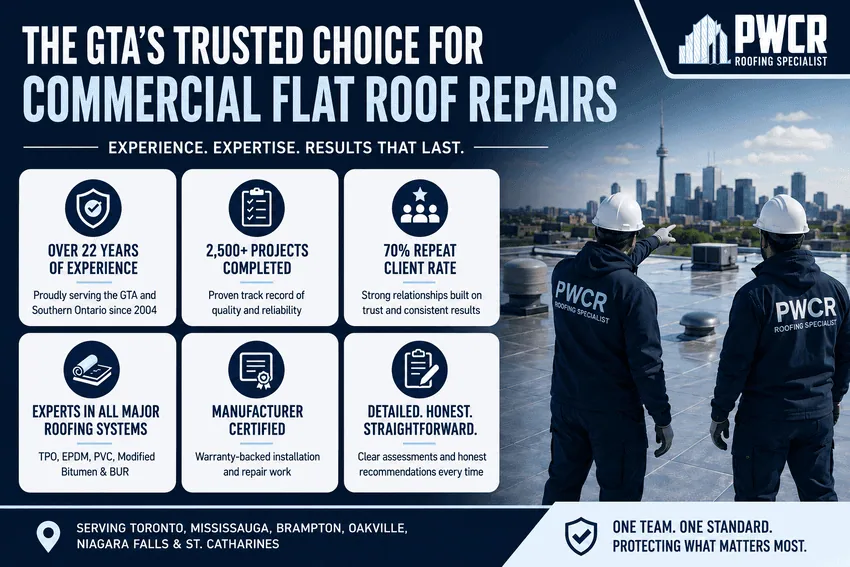
Founded in 2004, PWCR has been serving commercial property owners across Toronto, Mississauga, Brampton, Oakville, Niagara Falls, and St. Catharines for over 22 years. With more than 2,500 projects completed and a 70% repeat client rate, our track record reflects the kind of consistent, reliable work that keeps property managers and facility operators coming back year after year.
Our team works with all major commercial flat roofing systems including TPO, EPDM, PVC, modified bitumen, and BUR. We carry manufacturer certifications that allow us to offer warranty-backed installation and repair work. View our completed projects to see the range and scale of commercial roofing work we have delivered across Southern Ontario.
When a PWCR inspector walks your roof, you receive a detailed written assessment of what we found, what it means for your building, and what we recommend: repair, maintenance, or replacement, with honest reasoning behind each recommendation. We do not push unnecessary work, and we do not minimize problems that genuinely need attention. That straightforward approach is a large part of why the majority of our clients trust us with their properties year after year.
For commercial property owners in Mississauga, Brampton, Oakville, Niagara Falls, and St. Catharines, PWCR brings the same level of expertise and accountability to every project.
Don’t Wait Until a Small Roof Problem Becomes a Major Expense
Commercial flat roofs do not fail suddenly. They fail gradually through accumulated small problems that were never inspected, never addressed, and never given the professional attention they needed. By the time most property owners react, the damage is already extensive, the cost is far higher than it needed to be, and in many cases, what could have been a targeted repair has become a full replacement conversation.
Every season of delay on a known roofing problem adds to the scope of damage and the cost of the eventual repair. A drainage issue left unaddressed through one Ontario winter can mean saturated insulation and deck deterioration by spring. A failing flashing detail that gets patched over without proper repair will fail again, and each time, the damage behind it grows.
If you own or manage a commercial property in Toronto, Mississauga, Brampton, Oakville, or anywhere in the GTA and your flat roof has not been professionally inspected recently, the cost of that inspection is the smallest investment you can make to protect one of your largest assets.
Contact PWCR today to schedule a professional commercial roof inspection. With 22+ years of experience, 2,500+ completed projects, and a client base that keeps coming back, our team brings proven expertise in commercial flat roofing across Toronto and Southern Ontario, from targeted leak repairs and emergency response to full commercial roof installation and replacement. We will give you an honest assessment of your roof’s condition, your options, and what it will take to protect your building for the long term, before a small problem becomes a large, disruptive, and expensive one.